🎉 Sei schnell:
Unverzichtbare Rhythmus Basics
How to play accordion -
the ultimate beginners guide
- Updated: 07.04.2026
- Viewed +78.000 times
- Author: Matthias Matzke
Would you like to play the accordion?
Then you've come to the right place!
This article takes you straight to your first piece and answers the following questions:
 How difficult is it to learn the accordion? Is it right for you?
What do you need to consider when buying an accordion?
How do you play your first piece from scratch?
What other possibilities do you have with the accordion?
“With its countless buttons, keys, and rich history, the accordion may seem intimidating at first. But it’s an incredibly versatile and accessible instrument—one that you can learn at any age while enjoying hours of fun along the way!”
Tip: This guide is designed to help you start completely from scratch. If any section feels too detailed, simply use the table of contents to jump directly to the chapter you need at any time.
📖 Contents:
Accordion Jump-Start – the ultimate beginners course
Play your first song in minutes and build real accordion skills from day one. No prior experience required:

1. Before you start:
1.1 Why you should learn the accordion? (5 reasons)

If you’re reading this article, you’re probably already excited about learning the accordion! But if you’re not quite convinced yet, this section is for you. 🙂
We think the accordion is one of the most fascinating instruments to learn. Of course, we’re a little biased as accordion fans, but there are plenty of compelling reasons to choose the accordion as your first or next instrument:
1) You can create great sounds from day 1
Most instruments, such as the violin or trumpet, require a lot of practice to produce a usable sound at all.
The accordion, on the other hand, rewards you right from the start. You don’t have to “produce” the sound yourself – as soon as you press the keys or buttons and move the bellows, you play beautiful tones.
Many beginners play simple tunes like “Oh When The Saints” on their first day. Of course there are challenges to overcome, but you won’t have to struggle with weird sounds!
2) You learn melody, harmony and rhythm at the same time
The accordion is one of the few instruments on which you can play melody and accompaniment at the same time. This offers great opportunities! It gives you a versatility that hardly any other instrument offers . Because an accordion is like a whole band in just one instrument!
3) Making music alone or together
As the accordion takes care of the melody and accompaniment, you don’t need any additional accompaniment to sound great. You can play impressive pieces on your own, be it a tango, a polka or a pop song.
But the accordion is also fun in groups! It is a popular instrument in ensembles, from folk music and Balkan bands to jazz and rock groups or as an accompaniment to vocals.
4) Let off steam stylistically
Whether classical music, tango, jazz, pop, rock, folk music or even experimental sounds – the accordion can enrich almost any genre.
Of course, the playing techniques differ depending on the style, but you have everything you need in your hand.
5) Learning the accordion makes it easy for you with ALL instruments
Learning to play the accordion requires coordination, rhythmic understanding and musical sensitivity. These skills can easily be transferred to other instruments.
Many report that playing the piano, guitar or other instruments was noticeably easier for them because they already had a strong foundation thanks to the accordion.
With these five reasons, we hope to get you excited about the accordion. Whether you’re just starting out or looking for a new musical adventure, the accordion is always a good choice.
Are there any disadvantages to learning the accordion?
That is a legitimate question. After all, no musical instrument is perfect.
You could face two possible challenges:
1. Ear training: With instruments such as the violin or guitar, players have to tune their instrument before every practice session, which automatically trains their ear. Your accordion, on the other hand, is tuned by default. In a way, however, having an instrument that is perfectly tuned at all times is also an advantage 😉.
2. Isolation: Because the accordion is such a versatile and independent instrument, connecting with other players can sometimes be a hurdle. After all, on the accordion you are not dependent on the accompaniment of other instruments.
However, these challenges are easy to overcome. In order to develop a good ear, you can learn to play pieces by ear, or by knowing chords and harmonies from context.
A community with other accordionists and musicians helps to combat the feeling of being alone with your music. The exchange with like-minded people motivates you, is fun and helps you to improve.
That’s why we emphasize playing in community – be it through group lessons on the Accordio Membership (coming soon), online concerts and workshops where accordion friends can come together, exchange ideas and support each other.
1.2 What you can expect: Time, costs etc.
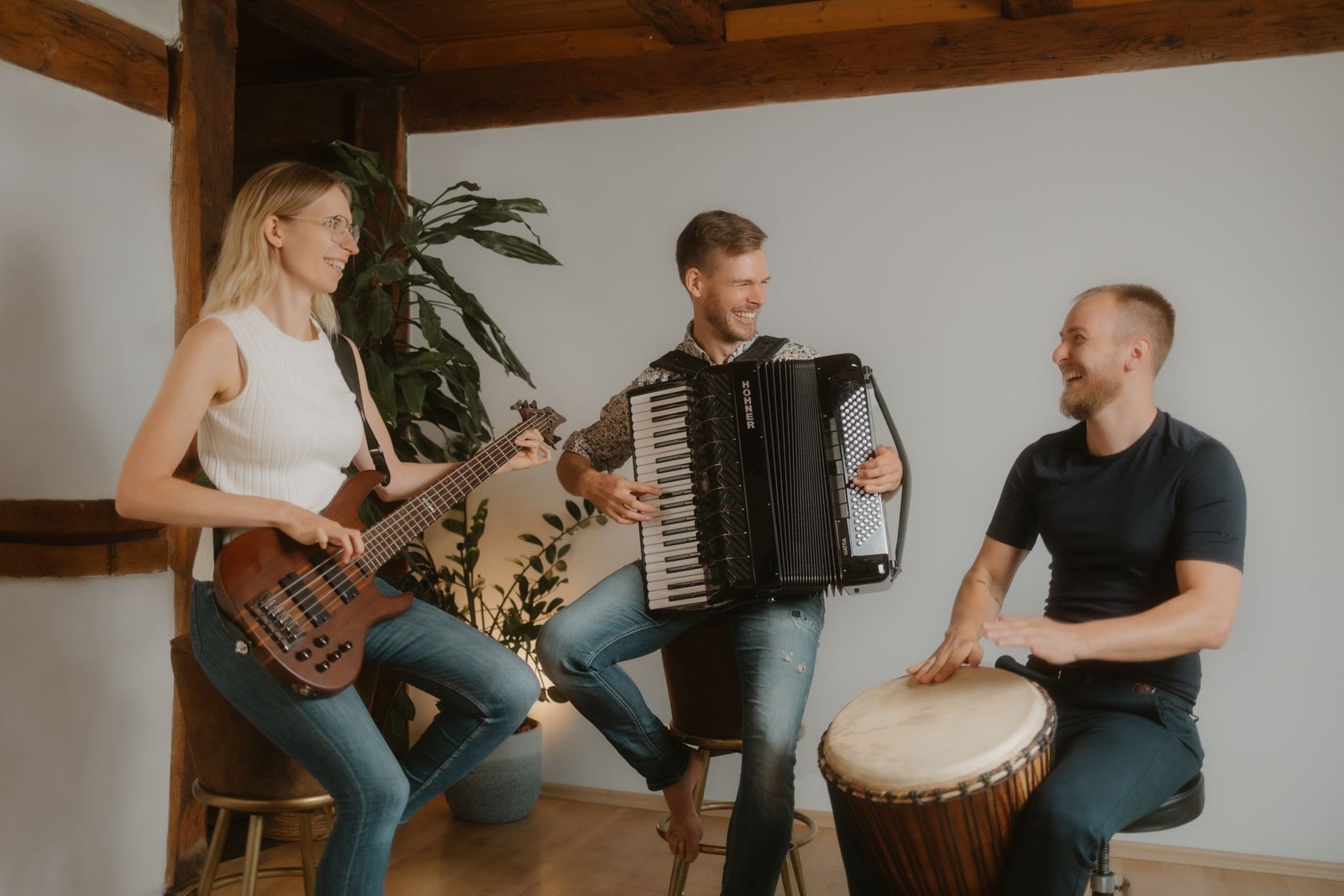
Playing the accordion is not cheap and takes time. That’s why we want you to know what to expect.
In this section you will learn all about the costs associated with learning and playing the accordion and the time involved.
How much does it cost to learn the accordion?
The main costs for learning the accordion include:
- Your accordion
- Lessons
- Sheet music
- Accessories
- Maintenance/repair
Buying an accordion – used or new?
Your instrument is probably the most expensive factor. Accordions cost anywhere from a few hundred euros to tens of thousands of euros. Depending on the make, model and construction. For beginners, there are inexpensive entry-level models and used accordions for around €300 – €500.
Accordion lessons costs
Music lessons at a music school or with a private teacher often cost between 30 and 100€/h, depending on the region and experience. Online lessons such as those on Accordio can be a cheaper and more practical alternative. We will go into the advantages and disadvantages of online and face-to-face lessons in more detail later.
Accessories
Accessories such as accordion straps, accordion bag or accordion case are usually sold together with your accordion.
You may need new accordion straps that can be adjusted to your height. Compared to other instruments, however, the costs remain manageable. This is because there are no wearing parts such as mouthpieces, guitar strings or drum sticks.
Accordion repair & maintenance
The maintenance of your accordion is only an issue every few years. Acoustic instruments can go out of tune over the years and felts and key coverings can also wear out. Digital accordions only need to be serviced in exceptional cases.
Accordion sheet music
You can find accordion sheet music from publishers such as Amusiko, but also in free form as a PDF download, for example here on Accordio: Accordion sheet music for free.
Is it difficult to learn the accordion?
No. As with any other instrument, it takes practice – whether you try it on your own, with accordion lessons or online on Accordio.
However, learning to play the accordion is much easier in parts than other instruments. With wind or string instruments, it takes a lot of practice to get the right tone.On piano or guitar harmonic accompaniments are quite challenging. On the accordion you can literally play both at the touch of a button.
Whether you are just starting out, already play other instruments or want to get back into it after a long time – the accordion is the most brilliant instrument for beginners of any age. Even learning the accordion at 50+ is very possible!
How much should you practise?
10-15 minutes a day is often enough to make audible progress. Especially if your main goal is to play your favorite pieces and cultivate a hobby.
You may have heard of professionals who practise for hours every day, often from an early age. Clearly, if you want to play at this level, you should be prepared to spend thousands of hours practicing, as with any instrument.
But don’t worry: you don’t have to practise for hours every day to set the mood with a solo serenade, accompany vocals or play with a band.
Of course, if you practise more, you will improve faster. But it’s not just about time – the key lies in the right method. If you know which skills you should train and how, then you can do it in the 10 – 15 minutes mentioned above.
The great thing about the accordion is that you don’t have to be at the top of your game to enjoy it. There is something suitable for every level, and even well-known classics such as “Libertango” or “La Cumparsita” are achievable with a little practice.
Playing the accordion is an enrichment – regardless of your level or your goals. The important thing is that you enjoy the journey! 😊
Can I learn the accordion on my own?
Yes, you can. Many accordion enthusiasts have taught themselves to play the accordion. This is also because it is becoming increasingly difficult to find good accordion teachers locally.
Even if you’re lucky and find a good one, it’s still possible that the teacher isn’t a good fit or has different ideas to you. Perhaps he insists on classical music, while you prefer to play pop songs or vice versa. Costs are also often an issue.
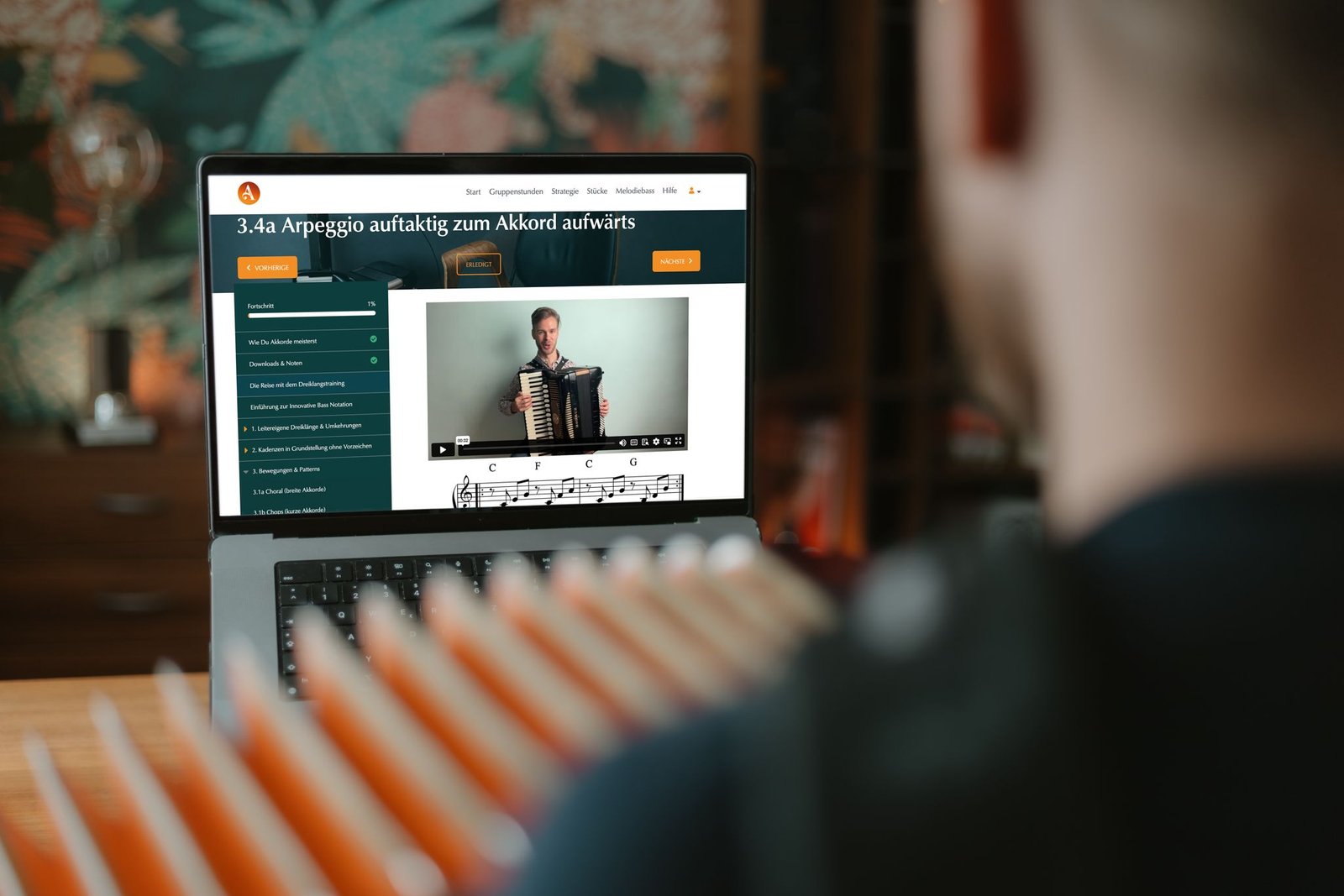
Online concepts are definitely worth a try: you can often even test the offers free of charge and without any obligation. With video lessons, you can press “stop” at any time and repeat passages as often as you like at your own pace.
It is advisable to get feedback from real professionals as soon as possible. That’s why Accordio always offers a mixture of self-study courses and group lessons, such as at the Accordio Membership (coming soon).
Your advantage: While lip tension or bowing technique, for example, require direct instruction from an expert for other instruments, the basics of the accordion can be learned very well via learning videos. Without a strict teacher sitting next to you.
Is it possible to learn the accordion without sheet music?
Yes, definitely! It is even much better to start learning the accordion without sheet music. After all, making music is about enjoying the sound, not about pressing all the black dots on a piece of paper in the right order.
Some people find it easier to play by ear at the beginning, others by note: A good teacher will tailor the approach to your strongest learning channel. Sheet music can always be used later to supplement ear training.
Playing by ear is also much easier than most people imagine. Especially on the accordion, it is more obvious than on any other instrument.
Why? Many folk songs, Christmas carols or even pop songs have a very similar accompaniment. With the right method, you can very quickly play many songs on the accordion without sheet music. Completely by ear.
The beginner course “Accordion Jump-Start” helps you learn by ear – or with sheet music. You can decide how you want to learn.
1.3 Learning the accordion as an adult
or even at 50+ ?

You may be asking yourself: “Am I too old to learn the accordion?” Never and never!
If you want to start playing the accordion as an adult, you even have some advantages:
1. adults are goal-oriented. You decide for yourself what you want to learn – be it a specific song or a technique. Unlike children, who often practise for the sake of their teachers or parents, you have full control. This increases your motivation and initiative enormously.
2. adults know how to work consistently. After a lifetime of experiences with school, work, family and other responsibilities, you know what it means to learn something new. This attitude and experience will help you to be successful when learning the accordion.
3. adults can organize their time. Yes, adults are busy. But they also know how to prioritize. That makes you perfect for self-directed learning. Just 15 minutes of practice a day is enough to hear progress on the accordion.
4. adults already have a feeling for music. The fact that you have been listening to music all your life means that you are way ahead of children! If you can hum a melody, you already have a good basis for playing and learning the accordion.
Let yourself be inspired! It’s never too late to learn a new instrument and enjoy music. No matter whether you are 5, 25, 50 or 75 years old! 😊
1.4 Which system?
Button or key?
This question is always the cause of heated discussions among accordionists!
Important: This has no effect on the sound of the music. The choice between button and keyboard accordion depends much more on what feels better to you.

1. keyboard accordion: A keyboard accordion has a keyboard similar to the piano. It is often the first choice for keyboard players and pianists, as other keyboard instruments feel familiar. Beginners usually find it easier to find their way around the keys and simple melodies can be played quickly – even by ear. Typical jazz playing techniques such as glissando can be easily implemented on keys.
2. button accordion: A button accordion offers more range in less space, as the buttons are arranged more compactly. With small hands you will find it easier to play large chord fingerings and melodic leaps. You can also move melodies to other keys more easily. Once you have understood the system, you can also play the buttons very well by ear. If you want to play the melody bass system on the left (e.g. for classical music), it is practical that the melody bass uses the same button arrangement. Button accordions are available in several systems, e.g. C fingering and B fingering.
👍🏻 Expert tip: To find out which instrument feels better in your hands, it may be worth trying out both systems at the beginning. But don’t make the decision unnecessarily difficult for yourself and, if in doubt, choose a keyboard accordion so that you are flexible. Because regardless of the “tool” you have at your disposal, music is created in your heart and head: the most beautiful goal is to develop sound perception and musicality – this applies to all instruments!
Chromatic or diatonic?
This question only arises with the button accordion and then it should rather be: What kind of music do you want to play?
- Chromatic accordion:
Chromatic accordions are versatile and suitable for almost all styles of music, from classical to jazz to modern pop music. You can play any key without restrictions, as the keys or buttons are arranged chromatically.
- Diatonic accordion:
Diatonic accordions are often at home in folk music, especially in traditional Austrian, German, French or Irish music. They are tuned to specific keys and usually have fewer buttons, which makes them lighter and more compact. However, they are less flexible. You can only play them in certain keys.
👍🏻 Expert tip: If you value versatility, choose a chromatic accordion. If you only want to learn folk music or traditional pieces, the diatonic accordion will be easier to start with.
Standard bass or melody bass?
The bass side of your accordion is crucial for the accompaniment and musical expression.
There are two systems:
- Standard bass (Stradella, Manual 2, MII)
This system is the most common choice for beginners and advanced players. It offers ready-made chords (major, minor, seventh and diminished) as well as individual bass notes. It is ideal for accompaniment and fluid chord changes.
- Melody bass (free bass, manual 3, MIII)
With Melodiebass you can play single notes over several octaves on the left – just like on the piano. As it allows you to play with maximum freedom and a finer sound, it is ideal for classical music and modern jazz. Harmonic accompaniments, however, require a deeper understanding of music theory and a lot of practice.
👍🏻 Expert tip: For a quick introduction and overview, we recommend the more common standard bass system. If you want to play more demanding pieces later on or are interested in more delicate classical music, you can always learn melody bass.
1.5 Online or traditional learning?
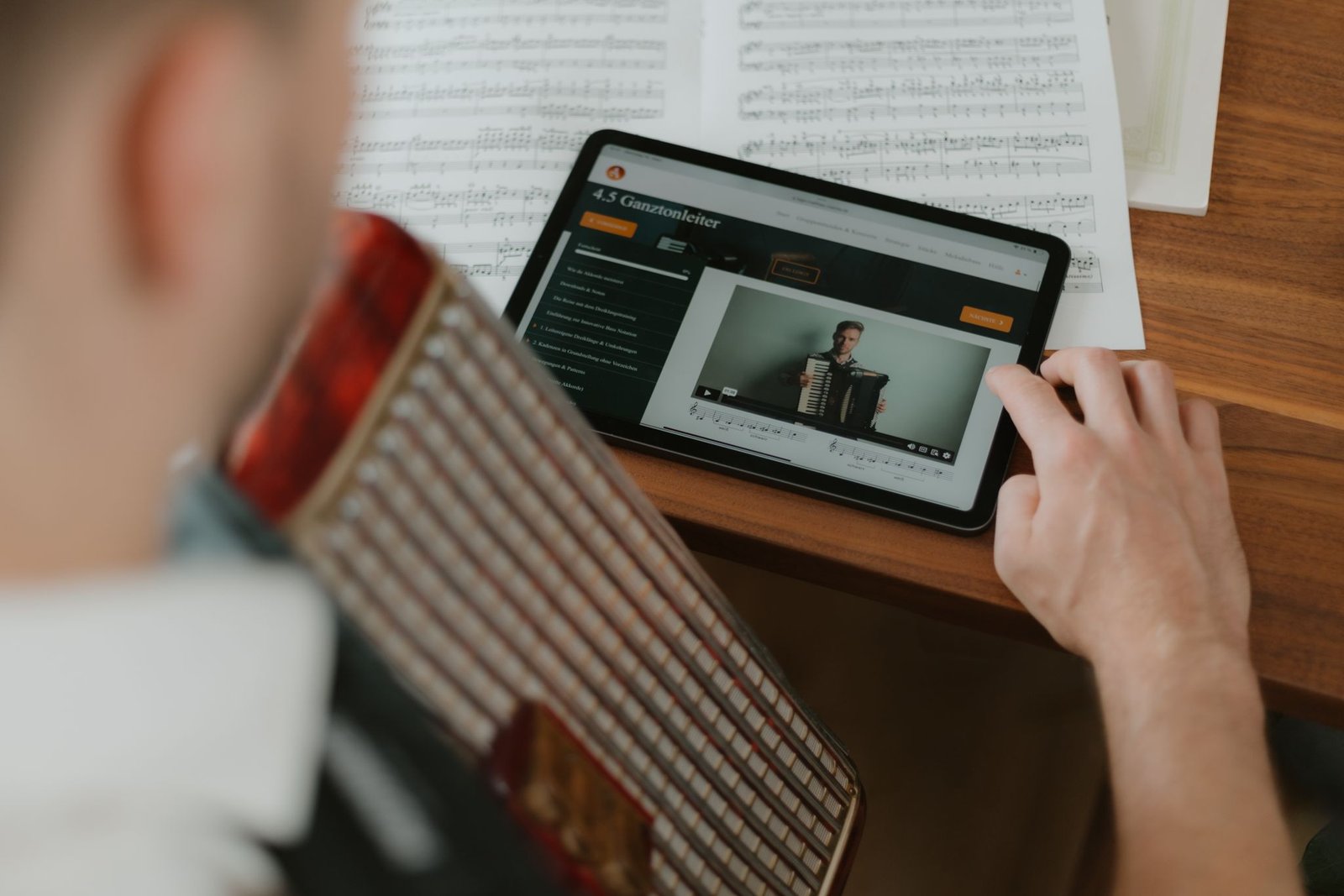
Apart from your accordion, this is probably the most important question: How would you like to learn the accordion?
Not long ago, your only option was to visit an accordion teacher once a week. Thanks to new technologies, there are more options today.
Let’s take a look at the pros and cons of accordion lessons, online courses, apps and self-study courses:
Accordion lessons
Pro
- Individually and in direct dialog
- Live feedback
- Making music together possible
Contra
- Higher costs (30 - 100€/h)
- Less flexible
- Difficult to find a teacher
Learn accordion online
Pro
- Flexible - learn whenever and wherever you like
- Significantly cheaper (from €39/month)
- Learn from a variety of world-class teachers
Contra
- Only partially individual
- Only partial live feedback
- No live experience
Of course, we fully support the Accordio learning method. The successes have been confirmed with over 250 adults of all ages.
It has been developed as the “best of both worlds”. However, we do not claim to make accordion lessons superfluous.
You can get a comparison here:
Accordion lessons
- 1 trial lesson usually free of charge
- Can cost up to €1,400 - €2,400/year
- Learn on site from a teacher with direct, personalized feedback
- 1 x 30 or 45 minutes/week
- No learning videos or support if you have questions in between
- No community or group offers
- Requires your live presence
Accordio
- Test 1 month free of charge
- From 39€/M (1 month free of charge)
- Learn from several specialized teachers - in videos and online group lessons
- Learn whenever, wherever and as often as you want - at your own pace
- Self-learning + feedback in group lessons and support
- Community of like-minded people
- 30-day money-back guarantee
Combine the methods
You don’t want to miss out on live contact and direct feedback from a teacher – but at the same time want to learn as flexibly, successfully and cost-effectively as possible?
Then try a mixture.
Many Accordio Members (coming soon) have private lessons and get additional inspiration and tips from some of the best teachers in Germany via the video lessons and group lessons.
 Expert tip: Try it out! Test a trial lesson with a teacher as well as, for example the bestselling beginners course “Accordion Jump-Start” wich comes with a 30-days money-back-guarantee.
Accordion Jump-Start – the ultimate beginners course
Play your first song in minutes and build real accordion skills from day one. No prior experience required:
2. buy an accordion
2.1 What you should look out for (tips)

Buying your first accordion – exciting and overwhelming at the same time!
And because this is one of the two most important basic decisions when learning the accordion, along with the learning method, we are currently writing a separate article in which you will find answers to even more questions. So here we will concentrate on the most pressing points:
1. what is your budget?
The price range for accordions is enormous: you can get hold of entry-level models for as little as €300, while high-quality professional instruments can quickly cost many thousands of euros. Think about how much you want to invest and search within this range. It’s best to reserve a budget for high-quality lessons: if you know how, even an inexpensive instrument will sound really great. And even a €30,000 instrument can be played to perfection.
If you would like an individual tip for your purchase, please send us an email to support@accordio-courses.com and tell us about your situation. We are happy to help! 🙂
2. what range do you need?
Accordions come in different sizes, which can be measured by the number of bass buttons: From 15 to 120 bass, this results in the keys in which you can accompany. Here is a rough overview:

15 basses
Reduced to the bare essentials for easy access

48 basses
Perfect for discovering all the basics

72 basses
Accompanying the most popular pieces - the standard for many

+96 basses
Accompany with 96 basses in all keys - you rarely need more
Acoustic or digital?
The subtleties in the sound and response of an acoustic accordion are fascinating. Digital accordions offer you more options in terms of sound and volume.
The timbres and moods of a wide variety of acoustic models come together here in a single instrument. Play with normal accordion sounds, additional orchestral sounds, synthesizer sounds and much more – all with just two hands on one instrument.
With Roland’s V-Accordion and the new KORG Fisa Suprema you have two great instruments to choose from. The latest digital instruments are also fully usable for beginners. You can use them to play all the techniques, playing styles and sounds of an acoustic instrument.
2.2 Buying or renting an accordion?
If you are unsure whether the accordion is really the right instrument for you, many dealers offer rental instruments from as little as €20/month. This is a great solution so that your instrument can grow with your playing skills until you are ready to decide on a longer-term instrument that is close to your heart. You will soon find an overview of good dealers here. If you are interested, please write to us at support@accordio-courses.com and we will be happy to put you in touch with a trustworthy address!
If you want to know how many basses and registers or whether you need a cassotto and whether you should rather buy a new accordion or a used accordion, we are currently writing a separate article for this.
3. let's go!
3.1 Your accordion at a glance
An accordion is not as complex as it may seem at first glance! All components follow a clear structure that you can quickly understand. Here is a brief overview:

Looks confusing? Don’t worry, we’ll shed some light on it in a few minutes. There’s a video in the next section. In it, I’ll show you everything in detail and you’ll also learn how to set up and adjust your accordion correctly. So let’s move on:
3.2 Setting up and holding the accordion correctly
To avoid damaging your accordion and your back, there are a few things to bear in mind when putting it on and taking it off.
After you have checked that all buckles and straps are firmly attached to the instrument, you can mount your accordion in one of 2 ways:
Sitting posture
- Your chair should be high enough so that your knees are at about a 90 degree angle. (Chairs that bounce up and down are not recommended).
- It is best to sit on the front edge of fixed chairs.
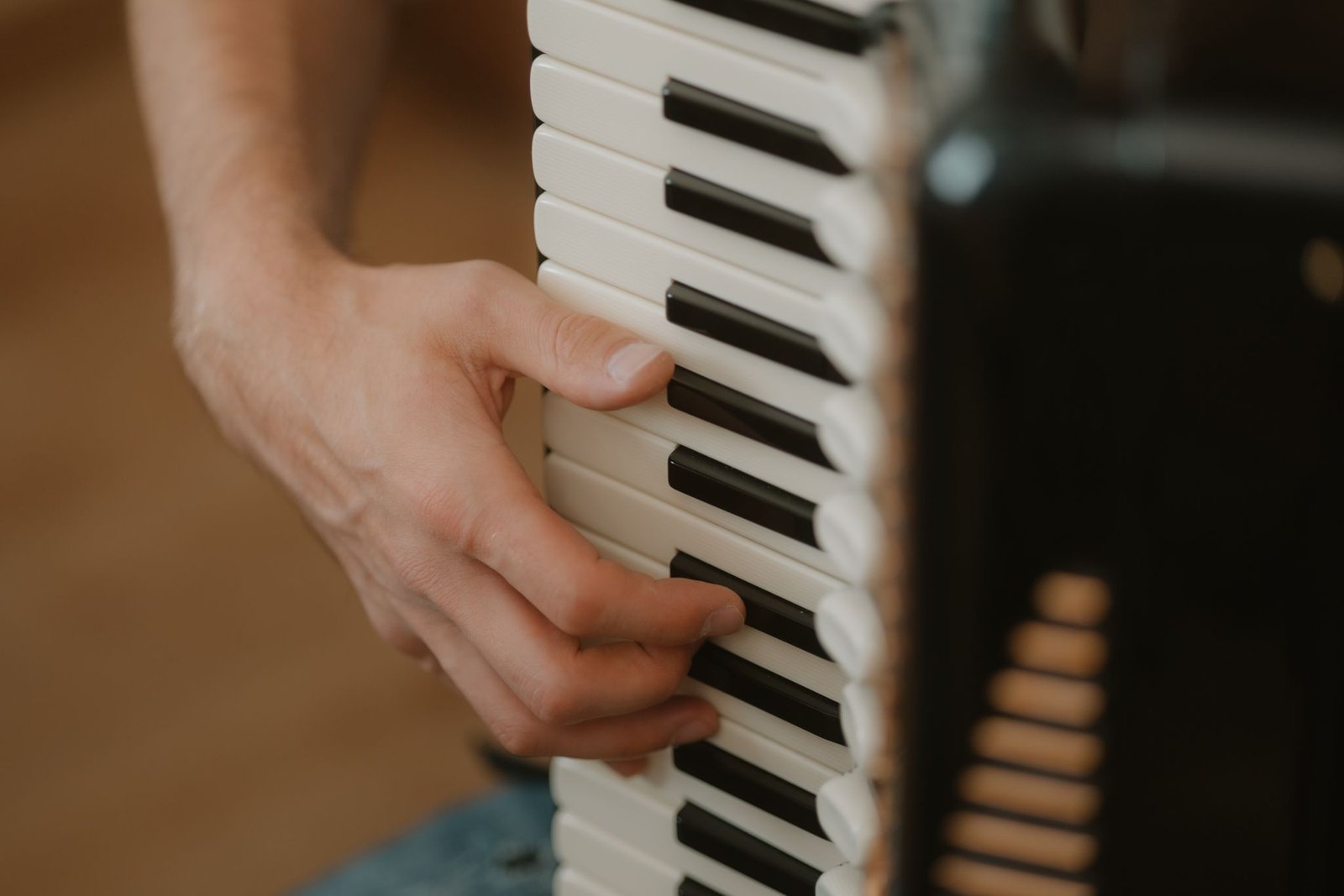
- Stand with your legs hip-width apart and your feet firmly on the floor. Stabilize the accordion with your right thigh (see video above)
Playing position
- Straighten your back - imagine that you are sitting tall and proud at the accordion.
- Pull your shoulders up once and then consciously let them drop. Now you have a relaxed playing position.
- Place your hand loosely on the keyboard. Be careful not to bend your wrist too much. Instead, straighten your elbow slightly.

Tip: “The air button is located at the top left of your instrument. This is not pressed when playing. It is responsible for opening and closing the bellows quietly. Before playing, acclimatize your accordion by only pressing the air button and fanning the bellows wide open and closing it again three times.”
Matthias Matzke, 3x 1st prize winner at the Accordion World-Championschips
The Accordion Letter:
Joining the growing community of more than 7,000 accordion enthusiasts.

★★★★★
View our ratings
Get free sheet music, workshops, and practical practice tips from the world’s best accordionists!
You are hereby signing up for the free newsletter. This also includes emails about courses and offers. You can unsubscribe at any time. More information: Privacy Policy.
4. Accordion basics
4.1 How to use the bellow
What the breath is to singing, the bellows are to the accordion. With a little practice, you can also make your accordion sing wonderfully:
“Just as a captivating narrative voice relaxes at the end of a sentence, emphasizes certain climaxes and uses pauses for breath to increase the tension.”
If no keys or buttons are pressed, a good bellows hardly lets any air through. Unless you press very hard against the resistance: Then the flaps may open on their own and make a murmuring sound.
The following exercises will familiarize you directly with the most important concepts of the bellows technique:
Bellows exercise no. 1: The sound of the sea
- Keep the air button pressed throughout the exercise.
- Press the air button and pull the bellows wide open, imitating a wave: first louder, then quieter.
- Once the bellows is fully expanded, keep the air button pressed and start a new wave by closing the bellows: get louder and then quieter.
- Repeat the exercise a few times with long and short, loud and quiet waves.
👍🏻 This is what you will learn:
Breath start & bellows stop: Feeling comes into accordion playing when we can create notes gently out of nothing (breath start) and let them disappear again very gently into nothingness (bellows stop).
You recognize the “grinding point” of the bellows and feel how hard you have to press to produce sounds later.
Tip: Let the weight of the bass work for you: You can do this by fanning out the bellows while pulling so that it remains closed at the bottom for as long as possible.
Tilt your upper body in the opposite direction of your left arm. You can lift your left buttock slightly when pulling. Many people make it unnecessarily difficult for themselves by, for example, also tilting their upper body to the left when opening the bellows. Try it out and see for yourself: you can find detailed instructions in the video.
Bellows exercise no. 2: Tire flatfoot
- Pull the bellows without pressing any buttons or knobs.
- While holding this resistance, quickly press the air button and relax your left arm. The noise should sound like a burst tire: A softer “Pfffffff”.
- Repeat the exercise under pressure and explore air sounds of different lengths and volumes.
👍🏻 This is what you learn:
Even if you play jerky accents and relax the bellows quickly, there is a certain basic tension.
Do you already notice that the button gets more resistance when the bellows tension is high? You should therefore always practise at the volume at which you are going to play: With a high bellows tension, the muscle tension on the left affects the dexterity of your fingers.
Bellows exercise no. 3: Chopped holding notes
- Vary the first two exercises by pressing a button or a button other than the air button.
- How does it work if you have fanned out the bellows to different lengths?
- Hold down a key or button and rhythmically change the bellows, e.g. short-short-long.
👍🏻 This is what you learn:
You don’t always have to move a finger to repeat a note: This is achieved in a particularly smooth way with bellows changes. At higher speeds, this technique is called shaking bellows or bellow shake.
4.2 Your fingers are up:
Right (melody)
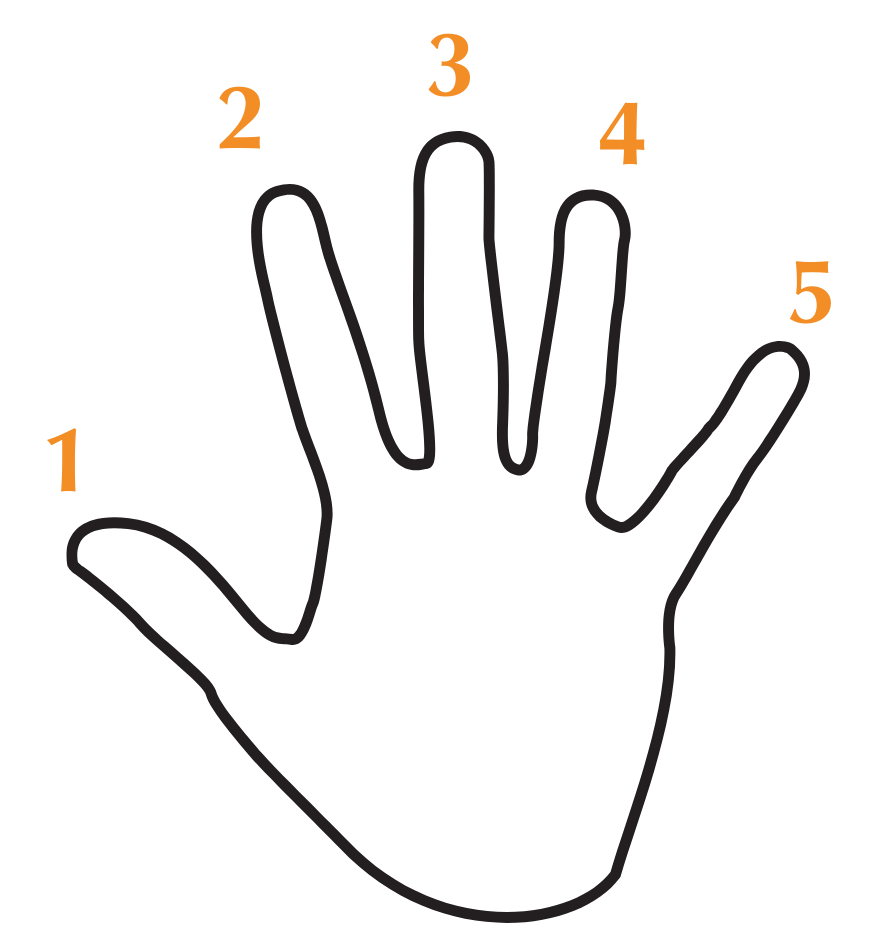
To know which fingers to play when, we count from the thumb:
1: thumb, 2: index finger, 3: middle finger, 4: ring finger, 5: little finger
These fingerings will help you to learn melodies and movements more quickly and easily. In sheet music you will therefore often find fingering recommendations as small numbers above the notes.
Two important tips on fingerings:
- Every hand is different! If you have the feeling that you are not getting fluent with a fingering recommendation, try alternatives. There is usually more than just one fingering that works.
- Fingerings only work properly in conjunction with the corresponding fingering technique: if a passage does not run as intended, the solution often lies in the fingering technique and not in the fingering.
4.3 Orientation on the buttons on the right
Getting your bearings on the keyboard and playing your first melodies is child’s play. Let’s take a look at the melody of “Oh When The Saints”, for example:
- Tone reserve: We play in C major for a smooth start. These are just the white keys.
- Finger position: The entire piece is played from one position: In basic C position.
The basic position:
How do we find the entry point and the c on the keyboard on the right?
Black keys are arranged alternately in a group of 2 and 3. Note that there may be an incomplete group of 3 keys at the top of your keyboard. It is therefore best to orient yourself from the center of the instrument:
- If you place your index and middle finger (3) on the black group of 2 keys, your thumb (1) can rest on the next white key: the c. This way you can orientate yourself blindly on the keyboard.
- Then place the other fingers finger by finger on a white key next to the thumb. Play in C basic position and finger by finger in scale steps.
This is how the 5-finger position sounds when you start at c – does the recording agree with you?
Super. And so it continues with “Oh When The Saints”:
Finger movement: You play the melody with a rolling movement from the thumb to the little finger. Only the index finger is skipped in fingering 1 (thumb), 3 (middle finger), 4 (ring finger), 5 (little finger). Don’t forget to pull and press the bellows! 😉
And that’s how it sounds:
Can you perhaps find the other notes of the melody by ear from this finger position?
The following video plays the melody in its entirety and gives you a taste of where the accompaniment on the left is about to take you:
4.4 The musical alphabet
We play the seven so-called root notes on white keys. You can derive their names from the alphabet. In German-speaking countries, there is only one stumbling block compared to the international standard: b means h! The “A-Ha” effect, which repeats the series, helps as a mnemonic:
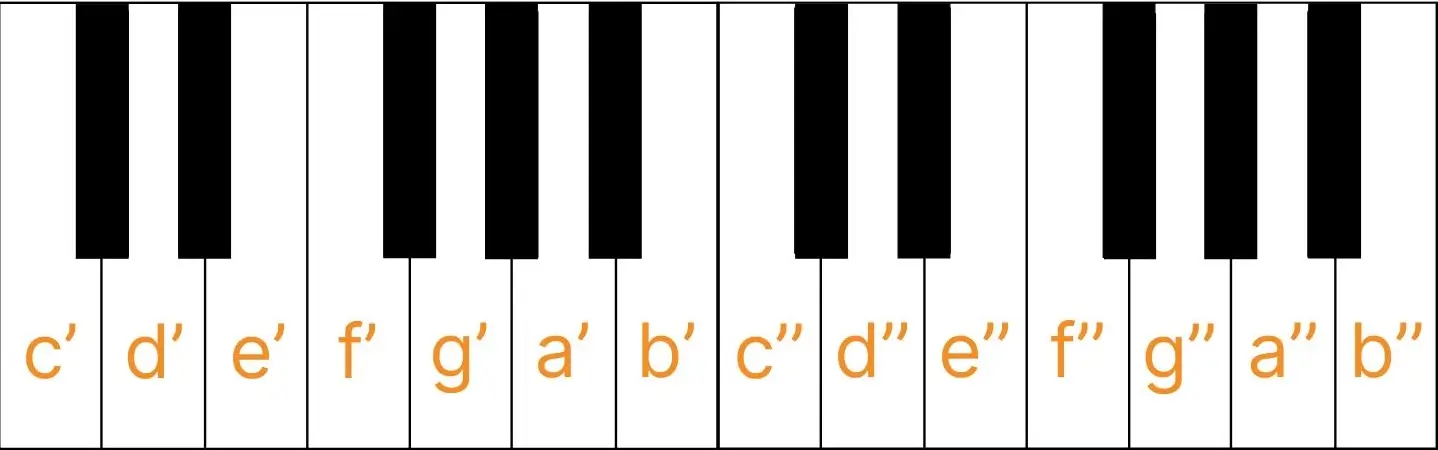
The number of dashes indicates the octave position. Alternatively, superscript numbers are written:
The lowest sounding c on the accordion keys is c’ or c1.
Let’s play “Oh When The Saints” to the end: At the top are the fingerings, below the note names – do you already recognize what the musical notation is all about? We’ll get to that in a moment, of course, so that the world of music is open to you even without note names and fingerings.


Note: On the accordion, notes in the right hand are higher when they are played towards the floor (lower). Lower notes sound towards the top (spatially higher).
Matthias Matzke, 3x 1st prize winner at the Accordion World-Championschips
4.5 Black keys, keys and accidentals
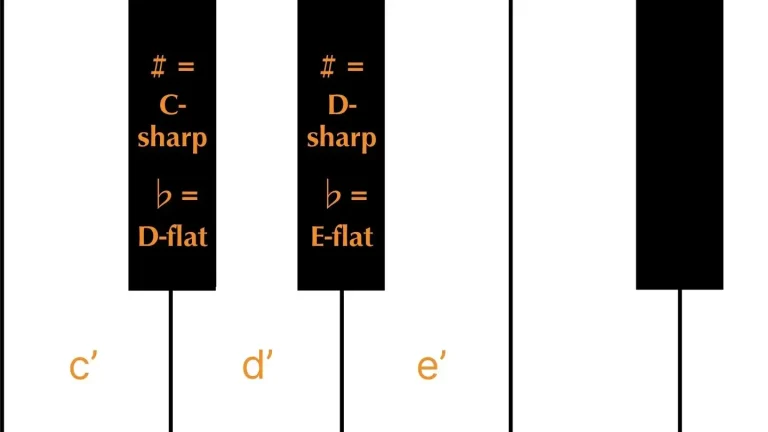
The note b also exists in German-speaking countries: it is located on the black key (tonally) below the b. What are the other black keys called and when are they played?
If you run a finger over the white keys, you will hear a scale that is perceived as the basis of classical Western European music.
If you let your finger move up and down further inside at the level of the black keys, you alternate between playing white and black keys. The sounds may remind you of Paul the Panther or The Phantom of the Opera. These melodies consist of semitone steps strung together, while the semitone steps e-f and b-c alternate with whole tone steps on the white keys. Whole tone steps in C major each skip a black key.
If you want to play in other keys, steps must be adjusted to maintain the classical scale character and white keys must be replaced by black ones.
Why don’t you start “Oh When The Saints” one key (tonally) higher at d: the finger position and movement remain the same, but can you hear what happens when your middle finger plays f instead of f sharp?
Does that sound the same to you?
Note:
If a key is raised by a semitone, the tone is called -sharp.
If a key is lowered by a semitone, the tone is called “-flat”.
4.6 The left hand: basses on the accordion
The up to 120 buttons of an accordion with standard bass are arranged according to an ingenious system: You can transfer learned fingerings and fingerings exactly the same to any key.
It is actually possible to understand everything about the basses on the accordion in just 15 minutes, so you no longer need a fingering chart.
To give you a quick and easy overview, I have created a free article including a free accordion bass chart. In the following video I explain the basses on the accordion:
The most important points in brief:
Colloquially, all buttons on the left are called “basses”. There are buttons for low single notes (basses) and buttons where several notes sound simultaneously (chords → accordion 😉).
These buttons are always arranged in the same system:
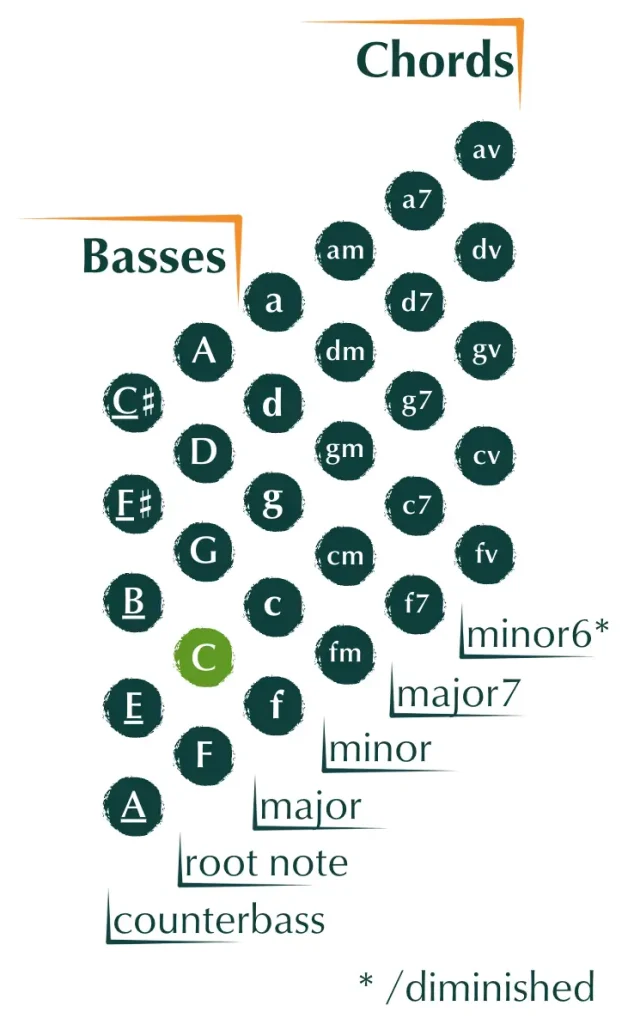
A guide on how to navigate blindly and permanently internalize the bass system can be found in this bass article.
If you run your fingers over the two rows with the “basses”, you will find a dented marking with the C bass at about the level of your lowest rib. There are also ribbed buttons. These are also used for orientation, but do not correspond to the C.
That’s how the C should sound for you too:
Did you find the slightly dented C? Super. And so it goes on:
- Place your middle finger (3) on the hollow with the C-bass.
- Place the ring finger (4) on the bass below and the index finger (2) on the bass above. This is how it sounds when you play your fingers in the following order: 3 - 4 - 3 - 2
👍🏻 Expert tip: “A mirror is a valuable exercise companion for orientation on the left! You can see straight away whether your fingers are correctly aligned on top of each other or whether your hand is crooked.”
With your fingers on these 3 buttons you can directly accompany the majority of all folk and Christmas songs! You can hear the chord changes even better in advance if you move your fingers from the tuba-like basic basses one button further to the left/outside on the chords. Play the following fingers there as before: 3 – 4 – 3 – 2
Give them the following characters in your imagination:
- Middle finger: calm and stability
- Pointing finger: Curiosity and excitement (like a raised index finger)
- Ring finger: solemnity and meaning (like a wedding ring).
When accompanying, you can first pay attention to how long a finger can remain in place and when you want to hear a change. With a little practice, you will hear the characters and changes in advance.
More about the basses and chords and a free PDF chart in this article ->
Let’s try this out directly with “Oh When The Saints” in the following video:
5. play your first song on the accordion
5.1 Rann to the notes
Sheet music is great for recording exact sequences. When playing together with other musicians, they create a common basis.
Unfortunately, it is often forgotten that this is neither the only nor necessarily the easiest way: children are the best proof that speaking and singing, for example, can be learned before reading.
Even as an adult, it is worth making music with all three learning channels:
- By ear,
- by notes and
- from an understanding of music theory
Reading music is not rocket science! The staff of the right hand consists of 5 lines. Scale steps are represented by note heads that alternate between the lines and the spaces between them:
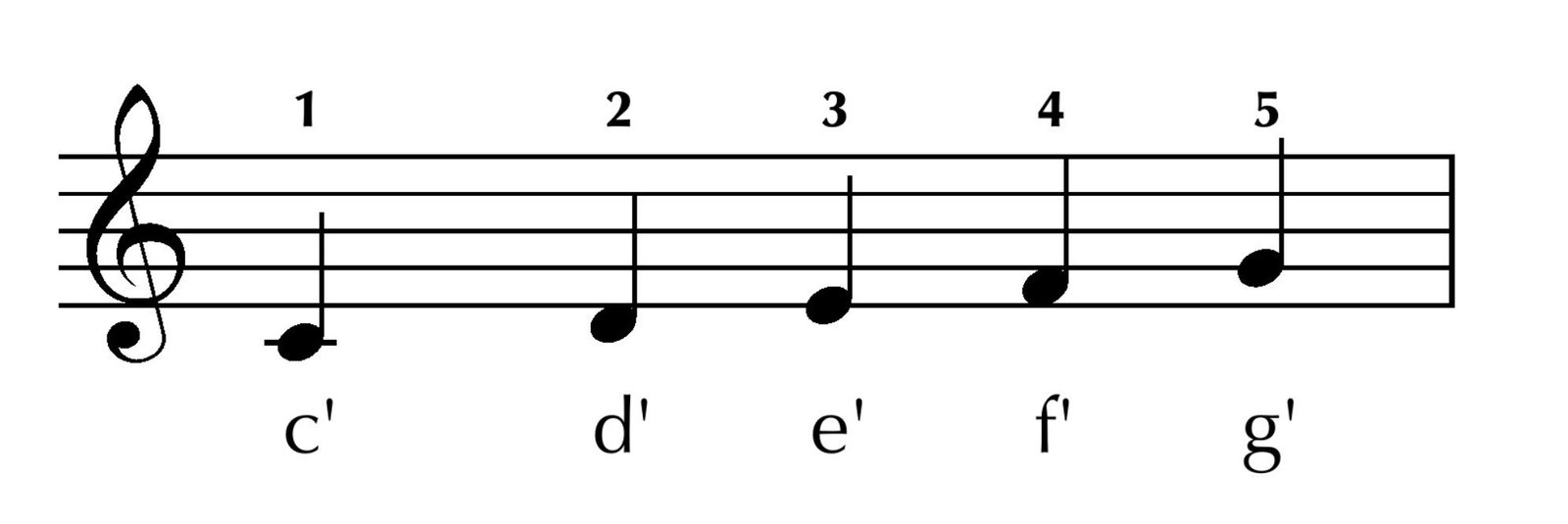
Note heads that are notated on higher lines and spaces also sound higher. If you imagine placing your fingertips on them with your thumb pointing downwards, they will mirror the movement of your fingers.
Note heads beyond the 5 lines are shown with short auxiliary lines: For example, our starting note c’ with an auxiliary line.
At the beginning of this staff is the curved treble clef, which indicates the pitch of the right hand. As it circles the note g’, it is also called the G clef.
3.1 Notation left (basses)
The lower sounding left hand is notated in a second line below. Derived from the piano, a notation with 5 lines is often used. The bass clef at the beginning of the line is also called the F clef: the note f lies between the two dots.
Since this notation does not correspond to the finger movement on the accordion and requires some practice, bass lines are often added with capital letters and major chords with lower case letters:
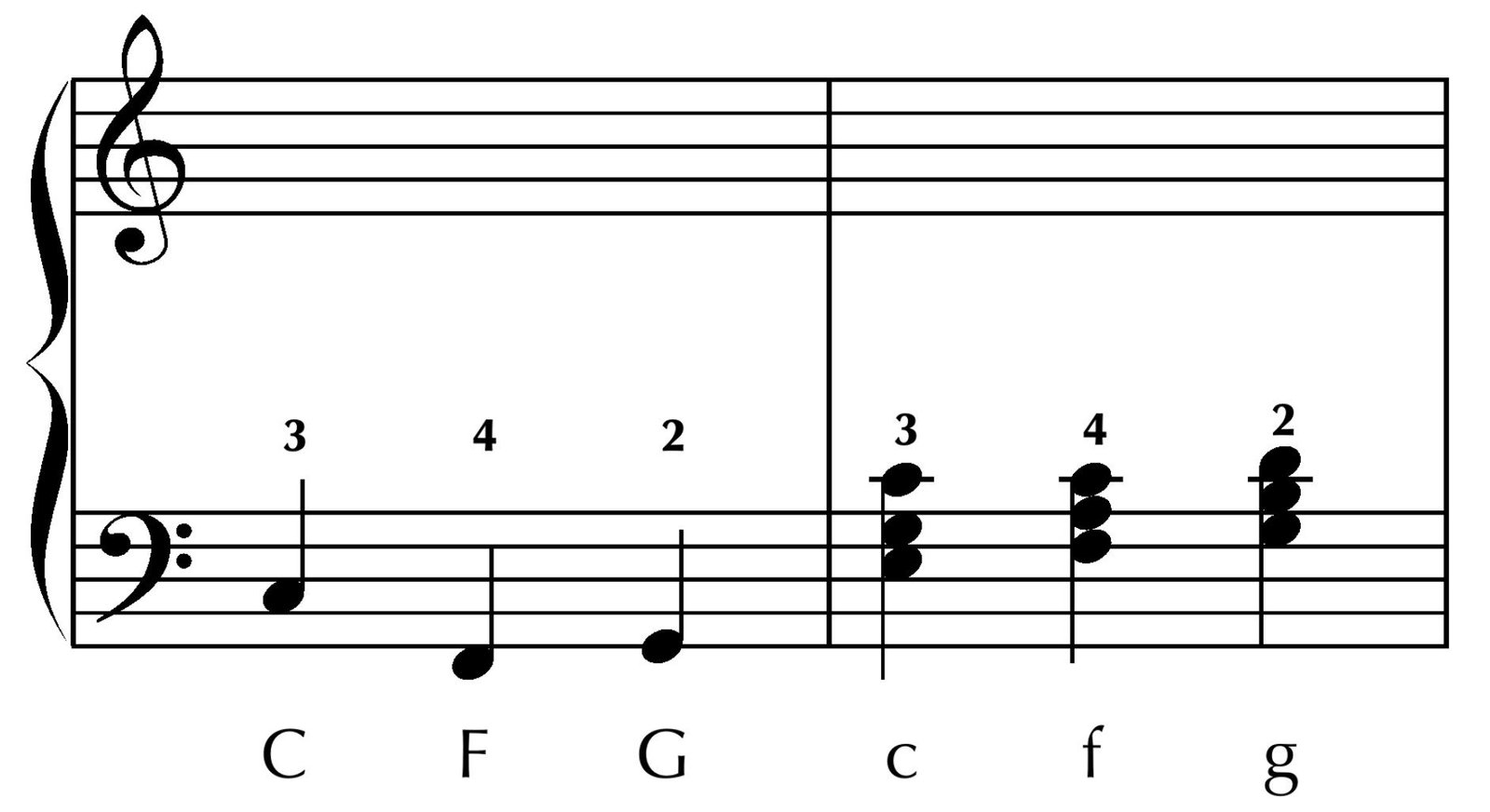
On Accordio you will find the following practical notation for finding finger positions and movements directly in the score. Basses are notated with normal note heads and major chords with crosses:
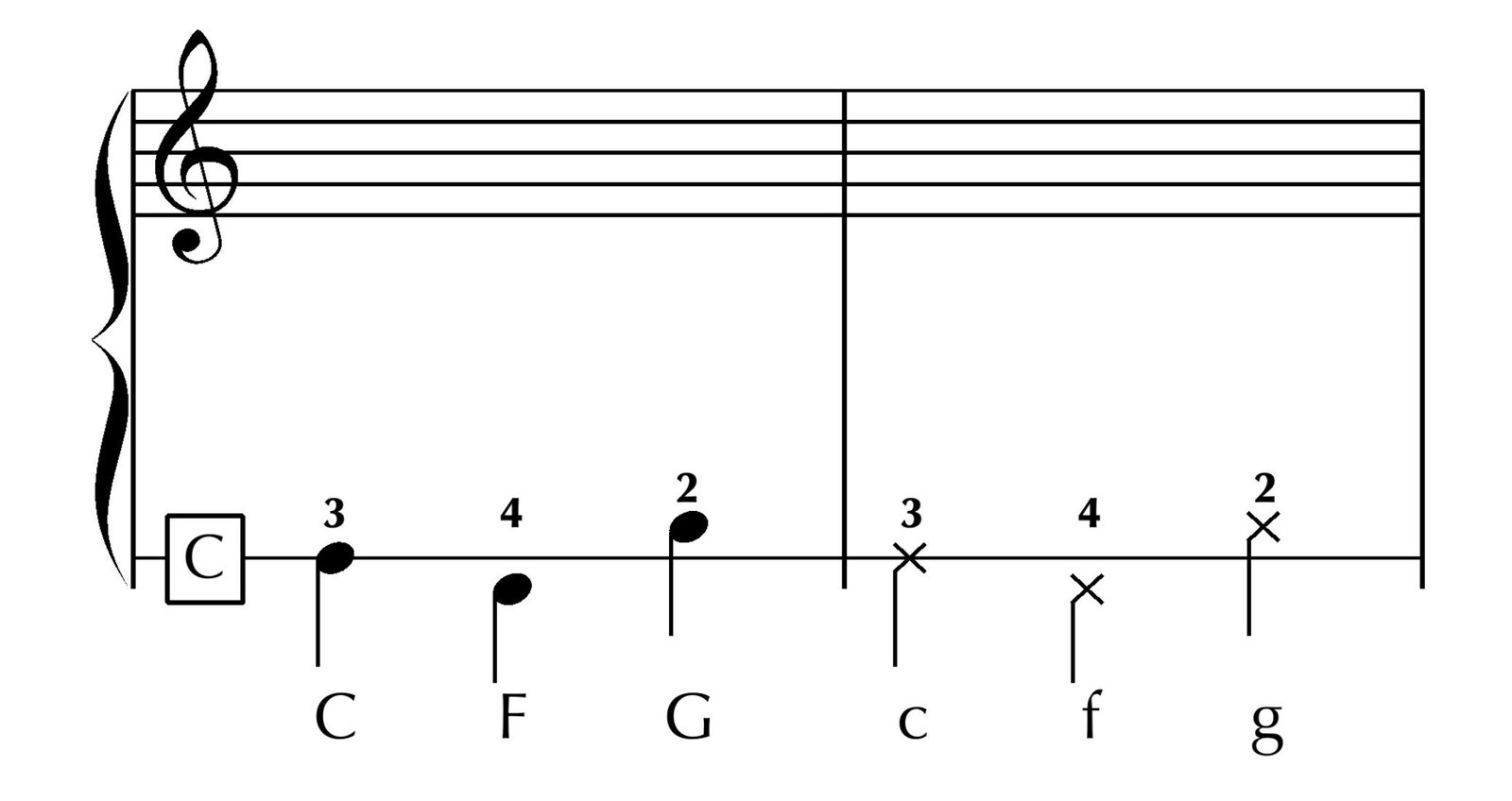
Different styles of music have a typical repertoire of accompaniment figures that have a very different invigorating effect on your playing.
3.1 Rhythms and accompaniment
To get started, it’s great to internalize melodies in a free, slow tempo with horizontal accompanying chords on the left. This will make your music sound hymn-like:
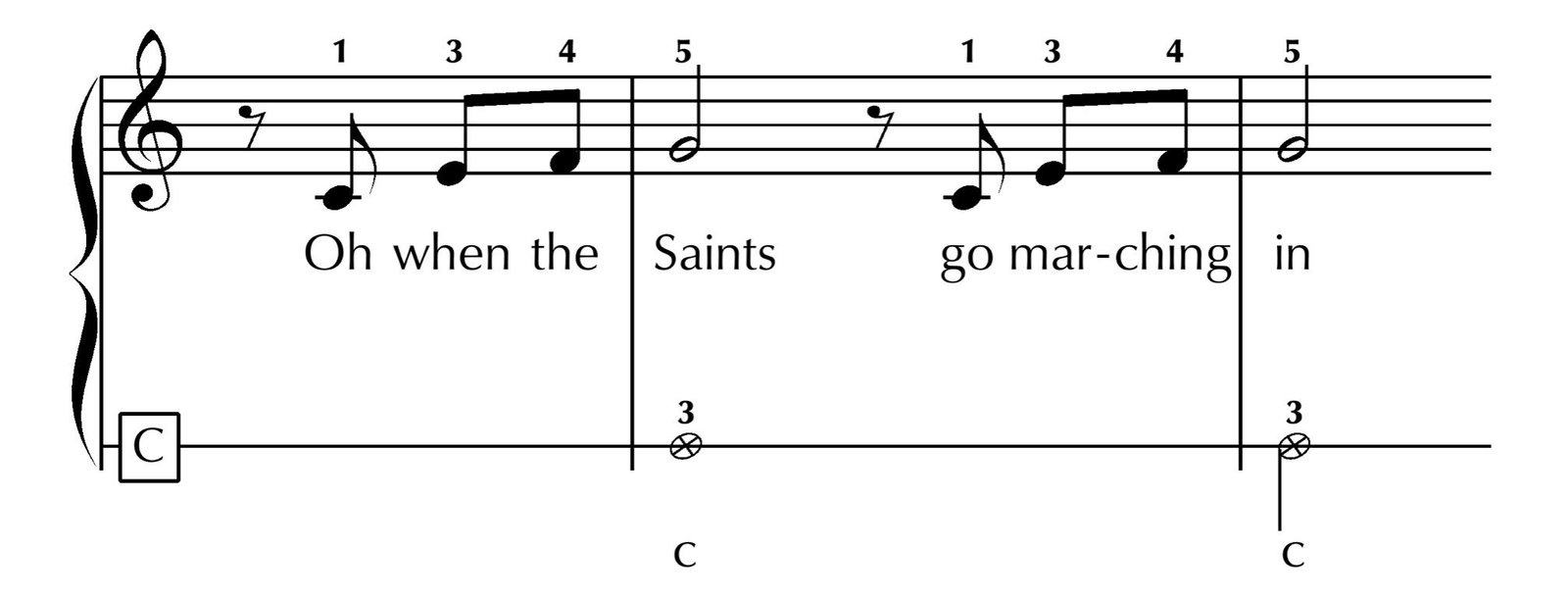
And this is how it sounds:
The note length is indicated by flags and beams on the notes and with filled and hollow note heads. We will go into this later, just play the rhythm by ear for now.
To get your playing going, introduce the pulse into the music by strumming at a regular tempo. Try repeated strums of the accompaniment on “Saints”:
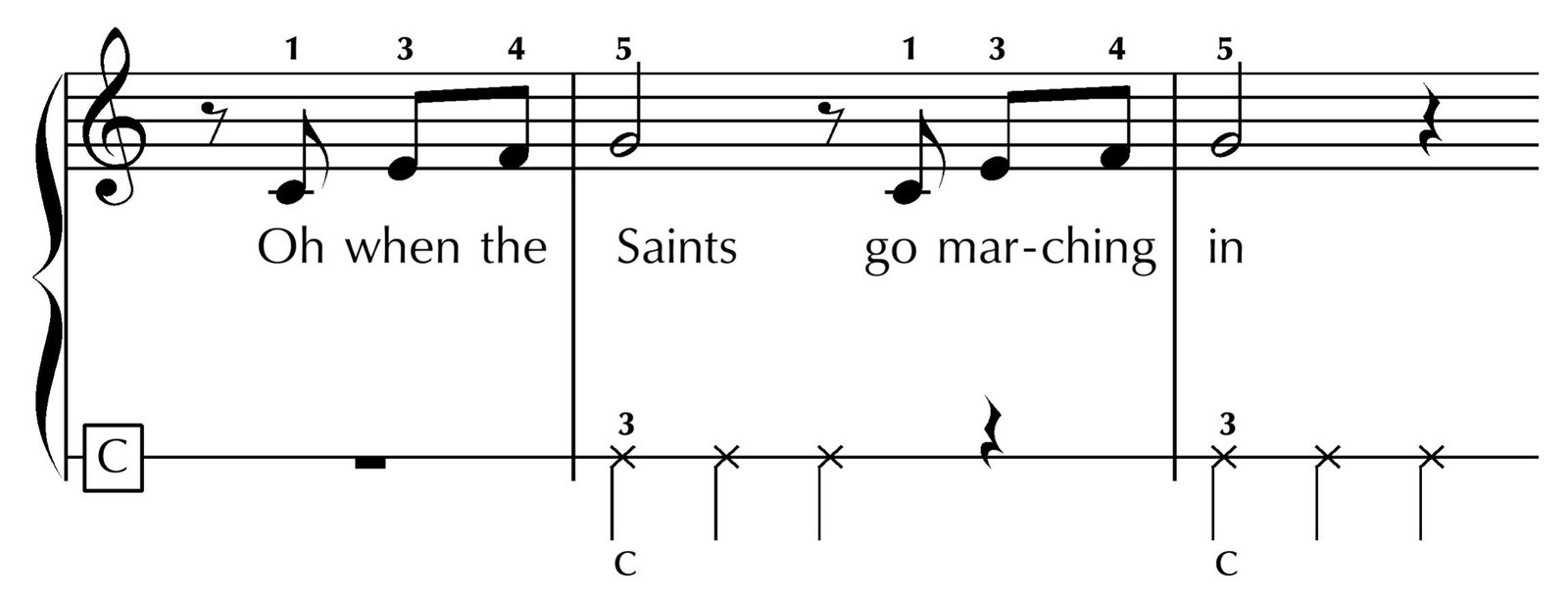
And this is how it sounds:
A bass-chord pendulum motion brings the music to a leisurely trot:
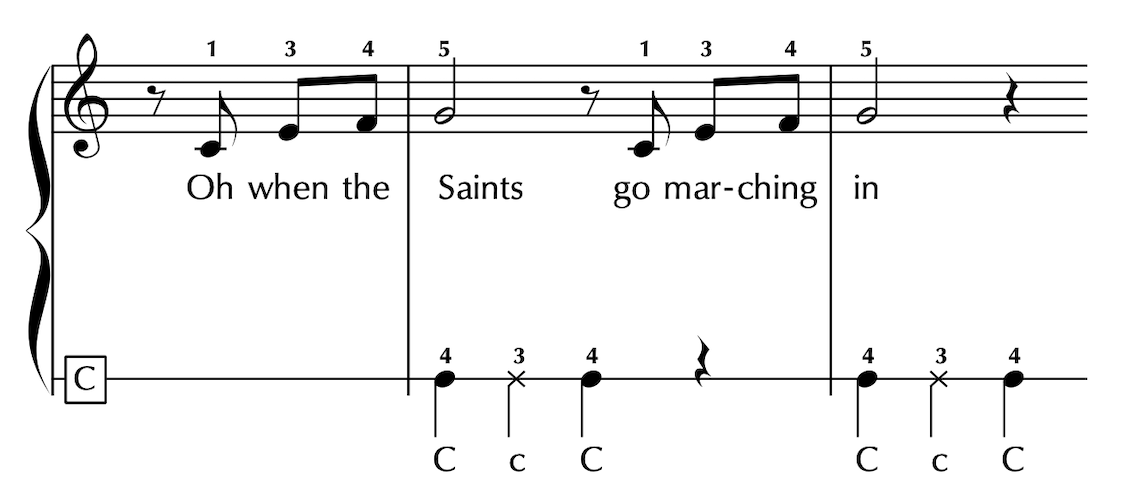
And this is how it sounds:
And you can really heat things up with the popular alternating bass accompaniment:
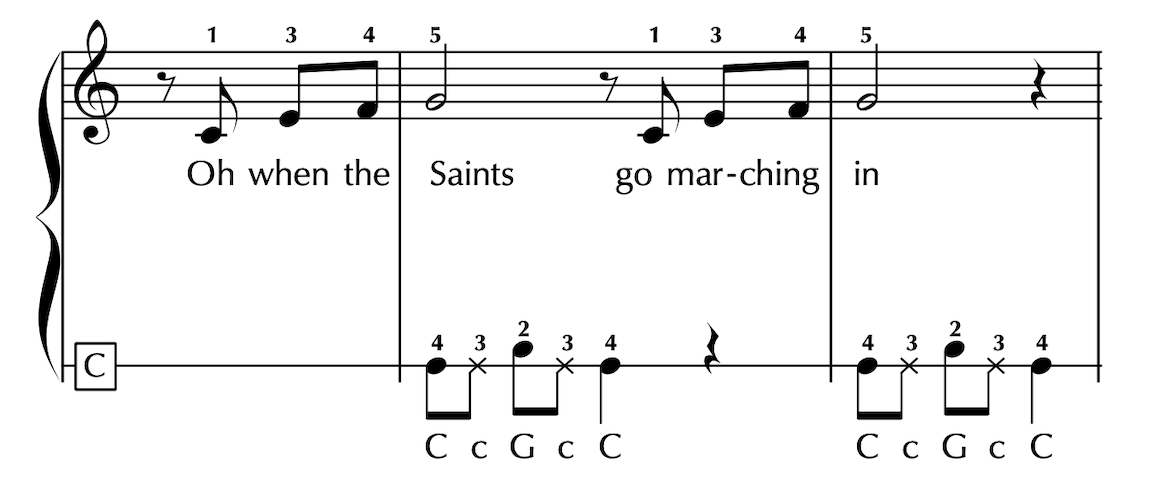
And this is how it sounds:
Different musical styles have a typical repertoire of accompaniment figures that have a very different invigorating effect on your playing. If you’d like an experienced guide to support you in your first steps –and want to start playing your first songs right from the beginning – be sure to take a look here:
Accordion Jump-Start – the ultimate beginners course
Play your first song in minutes and build real accordion skills from day one. No prior experience required:
6. discover genres
Here you can see what is possible?
Hardly any other instrument is so versatile and changeable. I myself really enjoy pushing the imaginary boundaries of the accordion again and again.
Because no matter what kind of music you want to play and no matter in what constellation – the accordion makes almost anything possible:
6.1 Playing folk songs on the accordion
Accordion sounds can convey the feeling of home and conviviality in a wonderful way – with roots in different cultures around the world: from Alpine polkas and Oberkrainer joie de vivre to shanties from the North Sea coast, Yiddish klezmer and Eastern European folklore.
Many popular melodies are easy to learn and always put you in a good mood. Perfect for social gatherings and parties!
6.2 Playing pop songs on the accordion
Pop hits and well-known evergreens are ideal for creating a rousing atmosphere with the accordion! Songs such as “Griechischer Wein” or “Rosamunde” are not only catchy, but can also be played wonderfully.
In the marquee, in the hut or around the campfire, unforgettable memories are made with the audience singing along enthusiastically, clapping their hands or swaying happily.
Pieces that you already have in your ear can be played more easily than most people can imagine – we already start with that in the beginners course “Accordion Jump-Start“.
6.3 Playing classical music on the accordion
Classical music is the root of everything: timeless, multi-layered, delicate and full of emotions that were as human and real hundreds of years ago as they will always be!
You can breathe new life into piano and orchestral works on the accordion: Works by Bach, Mozart or Vivaldi are given a unique sound by the accordion. Its dynamics and versatility move the audience and are also ideal for accompanying vocals and other instruments.
6.4 Playing tango on the accordion
Fiery rhythms, melancholy melodies and pure passion – tango on the accordion is simply magical. In addition to danceable and entertaining tangos, Astor Piazzolla’s Tango Nuevo is a true source of inspiration and demands both technical skill and emotional expression.
6.5 Playing jazz & swing on the accordion
The accordion is also at home in jazz! Its popularity before the advent of the Hammond organ may have been somewhat forgotten, but innovative jazz musicians such as Vincent Peirani and Richard Galliano are setting even more innovative accents today.
From swinging rhythms to improvised solos – jazz and swing offer plenty of scope for creativity and individual interpretations. The accordion unfolds particularly well in combination with other instruments in this genre.
6.6 Playing valse musette on the accordion
A piece of Parisian flair for your accordion playing! Musette waltzes with their typical ornaments and charming melodies will transport you and your audience straight to the street cafés of France. Full of lightness and joie de vivre, musette waltzes are a must for all romantics
6.7 Playing pop & rock on the accordion
Pop and rock classics can be interpreted just as fantastically with the accordion as many current hits. Whether it’s “Let it Be” by the Beatles or “Atemlos” by Helene Fischer – if you know how, the accordion is the perfect accompaniment and will make for surprised faces in the audience, who wouldn’t have expected their favorite songs in your accordion version.
6.8 Playing film music on the accordion
Playing the most beautiful soundtracks on the accordion is a real highlight!
From epic melodies from “Pirates of the Caribbean” to romantic music from “The Fabulous World of Amélie” – film music on the accordion gives you goose bumps and enchants you.
6.9 (Irish) Folk on the accordion
Lively jigs and melancholy ballads – Irish music inspires with its varied rhythms and catchy melodies.
On the accordion you can immerse yourself in the world of the Emerald Isle and create an authentic Irish folk atmosphere.
6.10 Playing world music on the accordion
Go on a world tour! In the truest sense of the word: with your accordion in your bag, you will be a welcome guest at many stops.
But even without leaving your four walls at home, music takes you to fascinating cultures where accordion sounds from Asia to Latin America are at home: From Balkan beats to Latin American rhythms – there are countless styles to discover in world music.
Be inspired by exotic sounds and experience the diversity of the accordion.
7. Learn accordion for free
Learn 7 pieces in 30 days
Wow, you’ve already learned a lot—and you might be wondering how and where to continue from here. Should you look for an accordion teacher, or is it possible to learn the accordion for free or online?
This is a crucial point, and let’s be honest: there are some great options available. For example, you can learn through our YouTube channel with free videos, our newsletter, and regular free workshops.
Especially if you’re just starting out, getting back into it after a long break, or simply want to find out whether the accordion is right for you, we have a clear recommendation:
“Accordion JumpStart” is the most comprehensive online course available for adult beginners. You’ll learn directly from Matthias Matzke and start playing from the very first lesson. Together, you’ll go through all the essential basics – and you’ll be amazed at how quickly you’re making real music. Even though the course is packed with valuable content, we’ve decided to offer it for just €27 so that everyone can get started. Take a look here:
Accordion Jump-Start – the ultimate beginners course
Play your first song in minutes and build real accordion skills from day one. No prior experience required:
